Famous Artworks That Bring Raceethnicity and Cultural Identity in Art
It is a cord of symbols, specific narratives, discourses, artifacts and objects that is never to exist untangled. Popular culture is a situation of constantly fluctuating interaction between various narratives, actors and practices. It is something that exists in the shared discourse of contemporary globalized civilization, seemingly lingering outside of the reach of minds that are constantly chasing its pregnant, yet nearly primordially already deeply influenced past it.
Trying to understand what is popular culture seems to be an try that tin never reach its purpose. There are just so many aspects one tin can grasp at a time, unsure if all characteristics are dwelled upon, yet certain that some will be left out. Nosotros will try to expect at some of the most significant theoretical frameworks needed to only first to unravel this puzzle, followed by discourses which have emerged as the most significant ones, e'er since this enigma of shared reality started encompassing our globe.
With this in mind, nosotros volition try to juxtapose these approaches and relevant concepts with some of the almost iconic examples of contemporary art practice in order to identify examples that might pb to answers. Which are the main elements that will lead u.s. on a path of understanding popular civilization? Are these elements nowadays in the practice of the public? What is the active interpretation? What is the place of a gimmicky artist inside the realm of pop culture? What is the significance of pop civilization symbols and which forms practice they take? What are the most important discourses that emerged in the terminal five decades, which determined the significance of popular culture? How does popular culture touch on our existence?

Starting to Understand Popular Culture
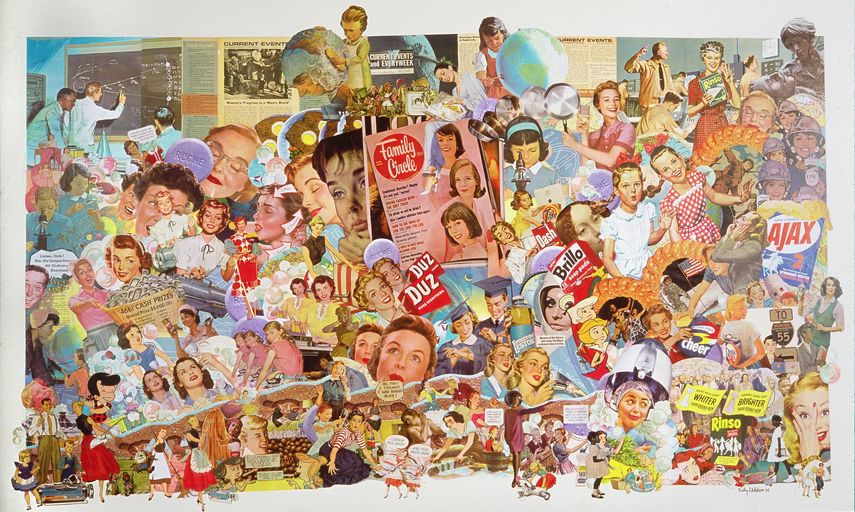
What is popular culture? A popular civilisation definition can be a subject field of a never-catastrophe public and academic discourse. Regarded equally the aggregating of different cultural products that are consumed by the majority of a lodge's population, pop culture is characterized bymass accessibility and entreatment. Coined in the 19th century, the term was traditionally associated with the gustatory modality of lower and uneducated classes as opposed to the official civilisation of the upper class. At the beginning and all through the first half of the 20th century, mass culture was perceived in ii unlike, but equally demeaning ways. Leftwing theoreticians saw information technology every bit something produced from the in a higher place, an attempt to passivize subordinate classes. On the other manus, the conservative school of thought saw the mass civilization as a vehicle of aesthetic, stylistic and even ethic deposition of (their) elite civilization. Perhaps the critics didn't sympathise that popular civilisation consumed by the masses was the inseparable companion of the emerging industrial globe and that presently both approaches would be proven wrong. As information technology became clear that the masses were not passive recipients of the products and practices from the mass culture, but quite engaged consumers and creators that shaped their own cultural globe, the field of pop culture became an arena for rebellion against the interests of ascendant groups and against their practices of cultural patronizing. Thus, the attempt to ascertain popular culture necessarily included the understandings of oscillations between the dichotomy control-resistance.[ane] At that moment, popular culture became intrinsically political equally much as aesthetical, a belongings that would define it until the nowadays twenty-four hour period.
After World War Ii, unlike innovations in mass media led to significant cultural and social changes and popular culture began to take new forms and a much wider reach. In a hardly separable flux of influences and inspiration, pop civilization shaped and was shaped by everything that was brought by new technologies, new media and the emerging consumer society. The meaning of popular culture began to merge with the practices of every mean solar day and by rejecting the cultural oppression coming from the official narratives, the realm of popular began including creators and consumers regardless of their class, gender or race. The house division between art, lower and higher culture had blurred, and all these notions became merged into 1 comprehensive term "culture", covering fields of guild, politics, economy and art that have been previously regarded as separate.
The Importance of Audience and Agile Estimation
Popular culture reflects both everyday life with all its pleasures and limitations and constitutes the public primarily equally a creative audition. During the 1980s and 1990s, the new moving ridge of audience enquiry was employed within communications and cultural studies to explore the way significant was negotiated and constructed.[2] Information technology was based on the reception theory that suggested that a literal text is not passively accepted, but that the reader can construct their ain pregnant based on their cultural background. Apart from the written language, cultural studies use the concept of text to also designate goggle box programs, films, photographs, and annihilation else that communicates ideas, values and interests. In this fashion, texts of cultural studies are comprised of all the meaningful artifacts of culture. The audience analysis emphasized the variety of responses to a given popular culture antiquity through an exploration of active choices, uses, and interpretations fabricated of popular cultural texts. As a qualitative and ethnographic method, this analysis tries to isolate variables like region, race, ethnicity, age, gender and income and notice the means in which different social groups construct different meanings for the same text. The audience can be agile, constantly filtering or resisting content, or passive, complying and vulnerable. The audition assay tin be traced back to the piece of work done by the British sociologist Stuart Hall and his new proposed model of mass communication. Emphasizing the importance of active interpretation within relevant codes, his model suggested that the same event tin be encoded in more than one mode, that the message contains more than than one possible reading and that the agreement of the message can be a problematic procedure. The work of Stuart Hall and the ethnographic plough accept significantly contributed to our agreement of the processes of interpretation and important relationships between media texts and the product of identity.
The Textual Analysis
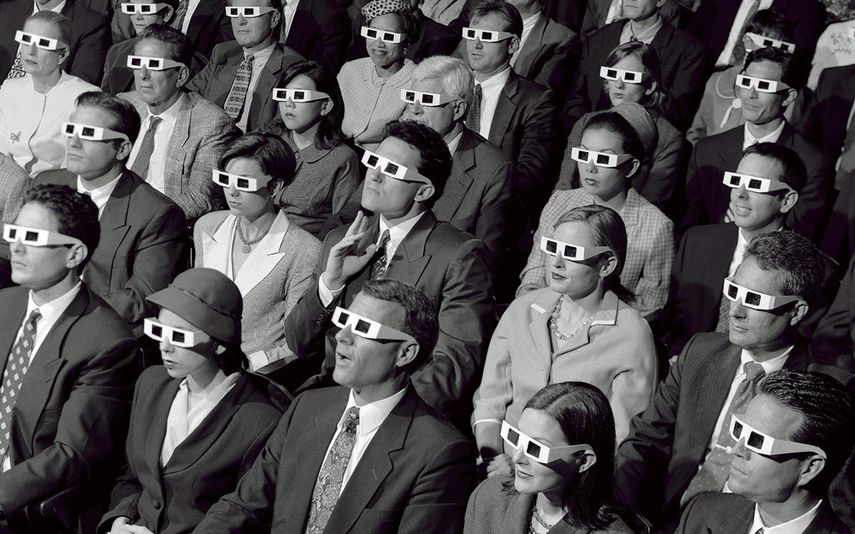
The method of textual assay has been widely applied in humanities and social sciences generally, and it has played an important part in cultural studies. Unlike the audition assay, the textual analysis uses the perspective of the author of the „text". Interpretative and content analysis are ii main forms of the textual assay of pop culture artifacts. Encompassing semiotics, rhetorical analysis, ideological analysis, and psychoanalytical approaches, amid many others, interpretative textual analyses aims to get beyond the surface meanings and explore more implicit societal pregnant. In this way, culture is perceived as a narrative or storytelling process where particular „texts" or „cultural artifacts" link themselves to larger stories within a society, participating in the construction of identities of those who employ them. On the other hand, content analysis is a more quantitative arroyo where qualitative data from the text evaluation can be converted into quantitative data that reflects the salient concerns of that particular discourse. It can be very valuable when linked to qualitative kinds of analysis which are usually somewhat subjective observations. Professor Jeff Lewis argued that textual study is the most circuitous and hard heuristic method that requires both powerful interceptive skills and a subtle conception of politics and context. Afterwards, textual analysis within the cultural studies framework evolved towards an emphasis on reception studies increasingly.[3]
The Discourse Analysis
Broadly, the soapbox analysis could exist defined equally the study of the socially determined utilization of language in any medium and its effects on the way information technology shapes and instructs the world around u.s.a.. It is a complex procedure that analyzes the language across the judgement, taking into account all levels of the text and context, likewise as the wider cultural background. The critical discourse assay is able to provide the understanding, skills, and tools by which we tin demonstrate the place of language in the construction, constitution, and regulation of the societal globe. The disquisitional soapbox analysis has been examining formal media such as newspapers and oral, written and visual political discourse, just is also applied to the analysis of popular civilization texts. The core instance of cultural studies is that language does not mirror an independent object world but constructs and constitutes it.[4] It is said that civilization works every bit a language and identities, as a central category of cultural studies of the 1990s are held to exist discursive constructions. Our thinking and our telling of experiences are structured by text-mediated discourses. Many discussions of popular civilisation have been structured by considerations of power, class, and gender. The assumptions underlying discourses on popular culture, such as assumptions concerning class and culture, the part of women, or authenticity and cultural doctrine, raise bug that should be examined critically in current discussions of popular culture.
Gender, Sexuality and Feminism
Gender has always been one of the strongest aspects of the homo notion of identity. From the quondam pre-Judeo-Christian ideas of binary gender, of 2 genders adamant by sex which, for ane reason or another, are in constant opposition and conflict, to the more contemporary definitions that intermission the concept into an entire spectrum of identities - it has always been something people strongly felt about. As such, it has also been an platonic vehicle for a multitude of artists to engage in discussions with the audience via their works. Mostly, how civilization is perceived, and how it is created, is based on gender, on the way the artist sees him or herself and feels the globe effectually them and on the way the audience reacts to what they're presented with - each through the lens of their own fix of expectations.[5]
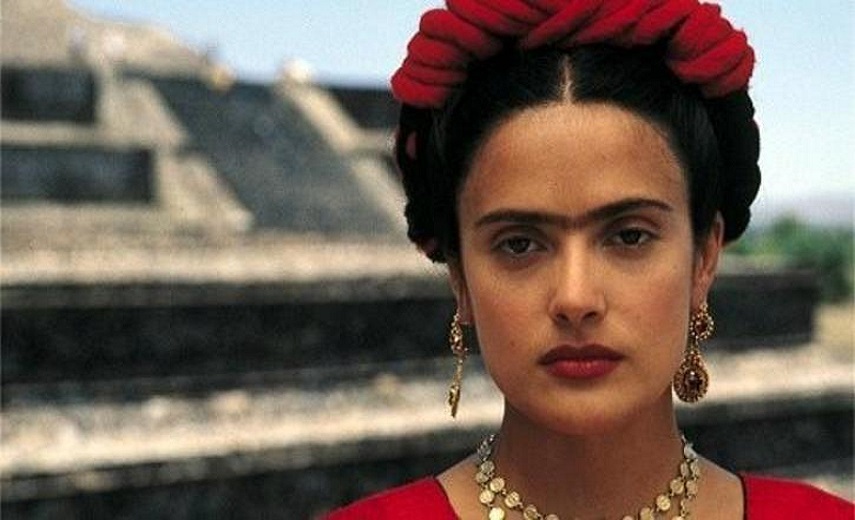
Having, in a way, been treated equally second-rate citizens in many societies, women have only adequately recently (almost a century or and so agone) won their rightful identify in the art earth and given a voice. Congruent with, and mostly beingness a product of the ascension of feminism, this has given the movement a powerful outlet for action equally well equally inventiveness.[six] Thus, the art world has given u.s.a. plenty of empowered, determined, and immensely creative women who are considered cultural equally well equally feminist icons of today. A biographical film on Frida Kahlo has made her fascinating body of work known to the masses, while Marina Abramovic became a household proper noun even outside of the fine art circles afterward a performance piece inspired by her work appeared on the globally popular Television receiver prove Sex and the City. Such cross-pollination of "high" and pop culture created a full circle, encompassing amusement, philosophy, the arts, social activism, politics and beyond.
Sexuality as an Inseparable Component of Pop Culture
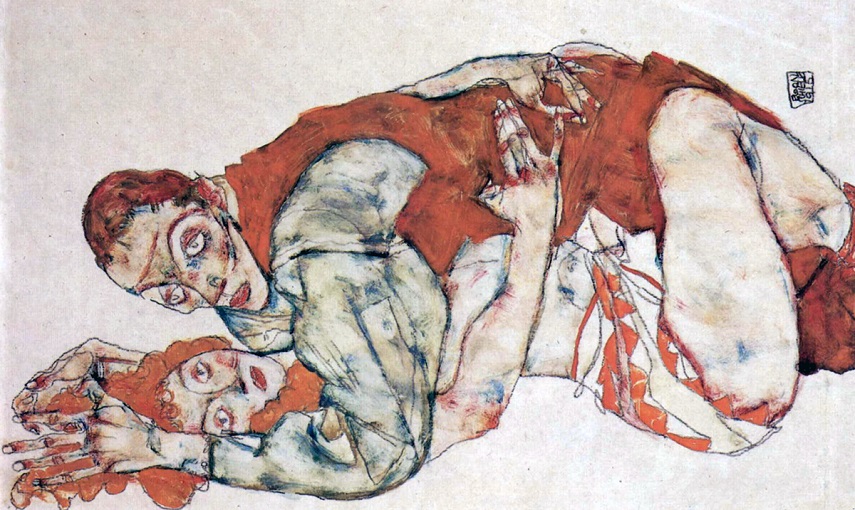
Sexuality has always been no less of a hot topic than gender. Depending on the cultural, religious, and moral climate, it was more or less an apologue in fine art. For centuries thinly veiled in mythological and allegorical subjects, the depiction of sexual themes became more than and more than bold, until Toulouse-Lautrec and later Egon Schiele started actually taking downwards the barriers with un-idealized depictions of existent-life situations of the more than intimate kind. Further down the line, the roaring 1920s and the hippie movement of the 1960s brought with them two waves of liberation, the latter of which is oft touted "the sexual revolution". Style, with its thought of the modern, free-thinking flapper, and later science, with the invention of the birth-control pill, both contributed to sex and sexuality being viewed as something to exist historic, rather than to be ashamed of. Throughout the 2d half of the 20th century, in the entertainment world, stars such equally Madonna did their share of the work in deconstructing old, patriarchal notions of modesty. The arts may have been leading the way but it was pop (or rather mass culture) that really tore downwards most of the barriers. And while today some more radical creative minds still explore sexuality in a very raw fashion, the theme seems to have lost some of its appeal due to its omnipresence in the media.
The Focus on the LGBT Community
LGBT topics, withal a somewhat controversial topic across the globe, are mayhap among the most discussed issues of our generation. Both popular culture as well as the more than avant-garde sections of the arts mimic this in sync. Of course, homoerotic themes have been effectually for centuries, albeit nether a deep cover of prejudice. Fifty-fifty though some pieces from the tardily Victorian era would nowadays be considered gay-themed (the canvases of Henry Scott Tuke immediately leap to mind), it was only in the late 60s and early 70s, hand in hand with the abovementioned sexual revolution, that the grip began to loosen and themes dealing with different kinds of love and sexuality could exist treated publically.[vii]
Lesbian art and its discipline-matter began to appear in works of artists with a feminist stance and unabashed gay erotica (and sometimes pornography) was the core of the underground work of Tom of Finland. Some of the biggest names of 20th-century fine art were, in fact, gay icons - Andy Warhol, Francis Salary, functioning creative person and Lucian Freud'south muse Leigh Bowery, legendary portrait photographer Annie Leibovitz, etc.
Be sure to check out works past Andy Warhol on our marketplace!
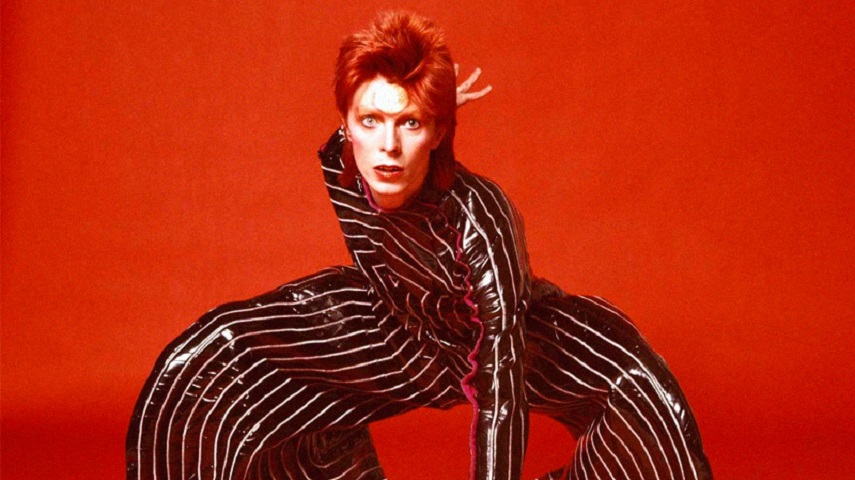
Music icons such equally David Bowie, Janis Joplin, Michael Jackson, Annie Lennox and many more explored androgyny and ambiguous sexuality both in their public personas and their performance. More recently, in the 21st century, themes dealing with the new means of looking at and expressing gender (forth with the increased visibility of transgender individuals) are as present in galleries every bit they are in the tabloid printing.
The HIV Pandemic and Beyond
On a more grim note, the HIV pandemic has been an sick-looking shadow to the otherwise positive and progressive aspects of the sexual revolution. It created a mass hysteria in the media and spread fear amongst the general population. Along with thousands of other lives, the illness took such avant-garde performers as Klaus Nomi and Leigh Bowery, likewise as one of the biggest rock stars in the world, Freddie Mercury. It is no wonder and so that the outbreak of HIV and its consequences made a shockwave through the fine art world, inspiring many artists to create new, moving, insightful, often warning images. Nicholas Nixon'south portrait photographs of AIDS victims in the 1980s captured with extreme realism the physical deterioration of the human body, making them a particularly poignant course of decay art.[8] All this has, in a way, given sexual freedom a somewhat tarnished expect, even so, as science continues to develop, nosotros tin just hope that HIV, along with many other diseases, will go a thing of the past. Whatever we were taught to believe, nosotros now can come across that our reality equally a whole is a developing one, in a constant state of flux, and that some issues demand to be readdressed over and over once more - in politics, in the media, and the arts - before they are truly dealt with. The renewed need to stand upward to racial prejudice and explore the causes of information technology is an obvious example of such unfinished business.

Race Vs Civilization
Race, ethnicity and culture are some of the most crucial concepts not only in the field of sociology only also in contemporary club. In its primary pregnant, race is a classification of people co-ordinate to their physical traits and geographic ancestry. If we think nigh it carefully, the notion of race plays an important role in everyday human being contacts and outcomes of such seemingly routinized interactions. Similarly to race, the term ethnic group is some other societal category that cannot be separated from the concept of culture. People who share the same ethnicity share common culture, including language, religion, customs, and history. It is of import to underline that both ethnicity and race became socially synthetic categories - they aren't based simply on biological traits anymore. To put information technology conspicuously, it is not and so much the biological differences that define racial groups, merely rather how these groups take been treated throughout history. In other words, how racial groups are defined is an ongoing and ever-changing social procedure.[9]
There have been numberless disputes, conflicts and wars fought in the proper noun of race and culture, usually fueled by discrimination between the two different parties. In information technology perhaps ingrained in human being nature to criticize and attack those who are dissimilar from u.s.a. and label them with derogatory, unpleasant words. This is exactly how racism was born and still exists despite the fact that we're function of the and so-called highly civilized modern society. On the other paw, at that place are such luminous examples of the 20th century as The Black Arts Motility. When it comes to culture, cultural wars are the result of conflicting ideas on the moral code, beliefs and values, which makes them ane of the omnipresent man issues. In a nutshell, the notion of race was originally based on concrete traits while culture on diverse beliefs and values, but due to globalization, the processes of cultural and racial mixing have achieved complex outcomes. People of the same race adopted different cultures, while people with the same culture may belong to different races. This miracle of blurred lines betwixt race and culture is prominent particularly in the The states, the very epicenter of globalization and immigration.[10]
Being Different in America
Racial and ethnic discrimination have been common in the United States always since the colonial era and the slave era. White Americans were given exclusive privileges when it comes to education, voting rights and citizenships, while Native Americans, African-Americans, Asian Americans, and Hispanic and Latino-Americans suffered exclusion and diverse forms of racial and ethnical discrimination. Such weather condition formally lasted from the 17th century until the 1960s and they are well-documented in various propaganda posters and documentary photographs. Racism reappears fifty-fifty in today'southward pop culture, ordinarily in the form of detest oral communication or discriminating visual materials.
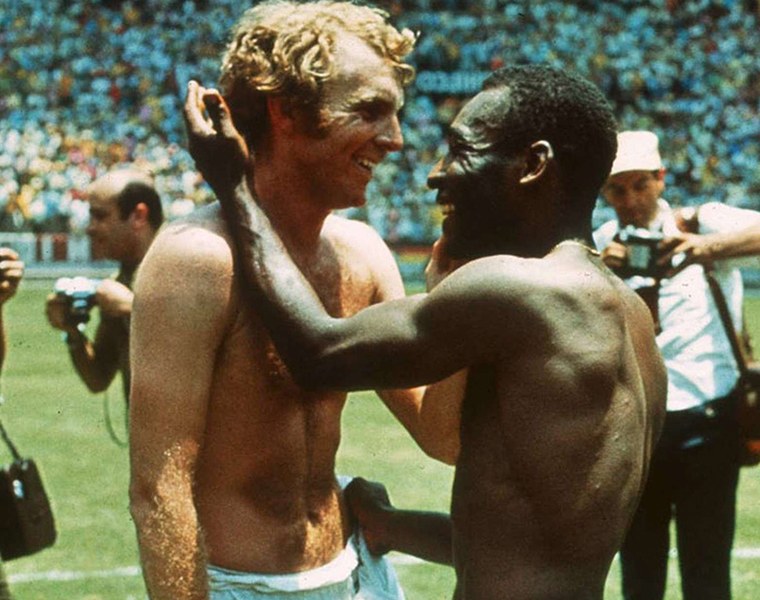
As a natural response to diverse forms of social inequalities, anti-racism was born in the United states of america to promote the thought of an egalitarian society. By its very nature, anti-racism tends to promote the idea that racism is dangerous, socially pervasive and that it has to be completely eliminated for the sake of global welfare. Just like there take been numberless examples of racism in gimmicky culture and arts, the same goes for anti-racism and famous people who have been promoting it. These supporters of egalitarian society come from the about versatile backgrounds, oft related to popular culture, politics and sports and their work along with their personality and appearance got immortalized in the form of photographs, posters and memorable quotes. Let usa accept a expect at some of the almost iconic ones...
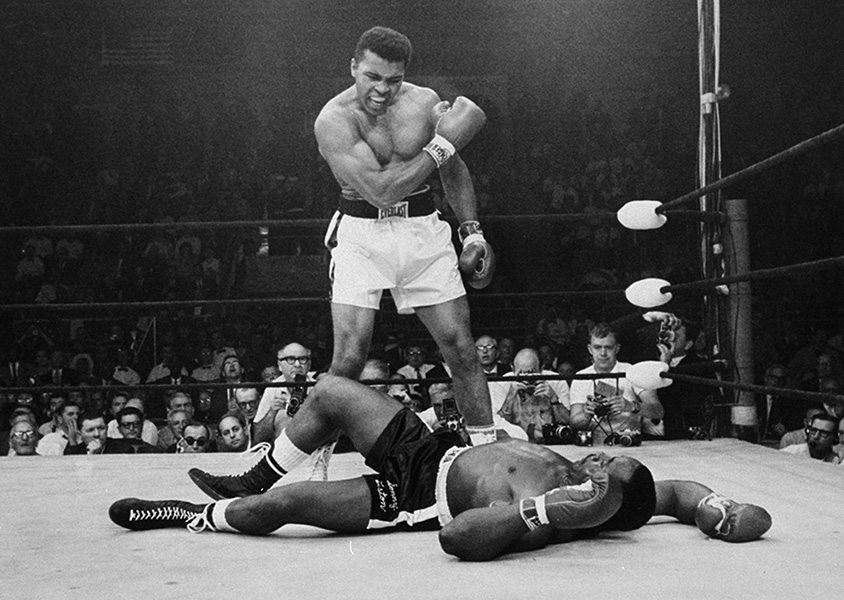
Muhammad Ali Portrayed by Neil Leifer
"Why should they inquire me to put on a compatible and go ten yard miles from home and drop bombs and bullets on brown people in Vietnam while so-chosen Negro people in Louisville are treated like dogs and denied elementary human rights?" These are the famous words of Muhammad Ali, who refused to go to the Vietnam War. Every bit much as Muhammad Ali was known for his actions within the ring, the same goes for his words and attitude. Ali was oft photographed by Neil Leifer, a famous American photographer and filmmaker known mainly for his work in Fourth dimension Inc. magazines.
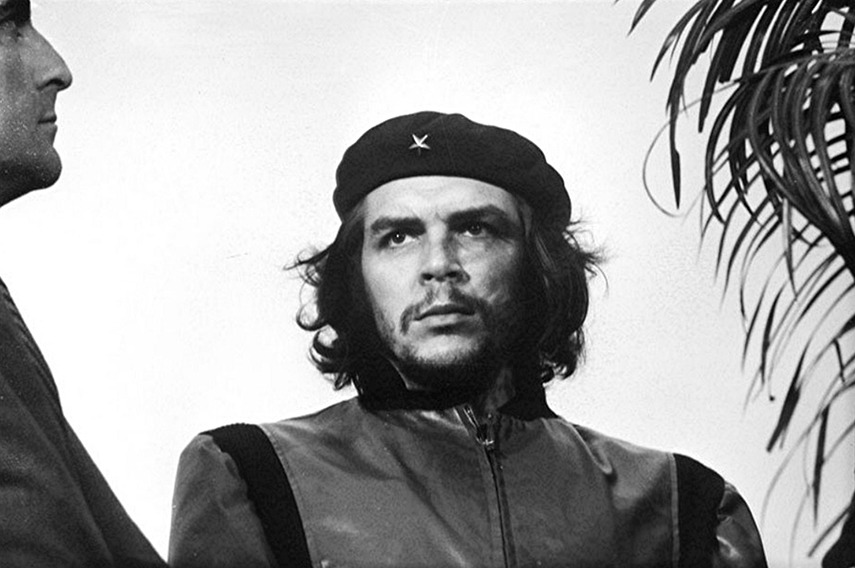
Hasta la victoria siempre!
Che Guevara was an iconic Marxist revolutionary and alongside Fidel Castro the primal figure of the Cuban Revolution, the fight against American oppression. Because of this, it'due south interesting how history changed and the famous photograph by Alberto Korda, Guerrillero Heroico, became more than famous than the person in information technology. Today, t-shirts with Che Guevara's face based on the Korda'due south photograph are nevertheless beingness sold worldwide, years later on the Cuban hero stopped fighting the mass-consumerism.
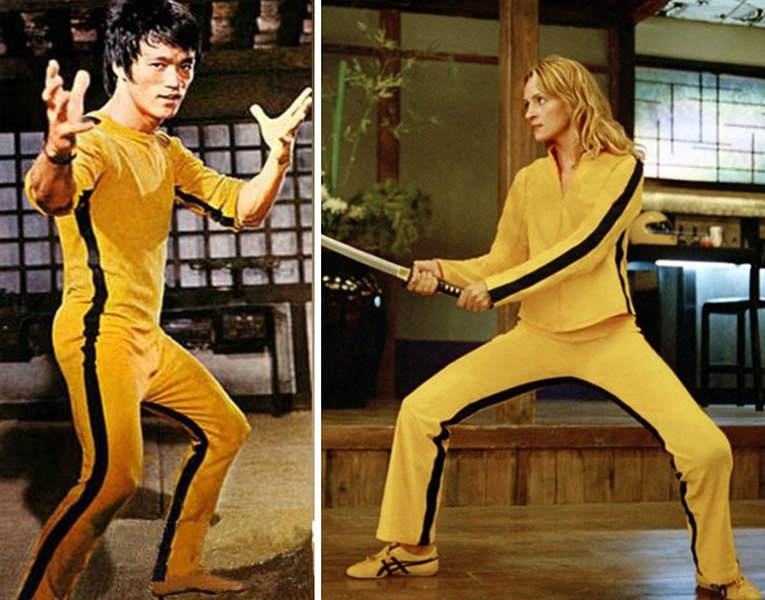
Bruce Lee and his Famous Xanthous One-piece
Fifty-fifty more than three decades afterwards his death, Bruce Lee is nonetheless i of the most influential popular culture icons in America merely also worldwide. In 1999, Lee was named one of Time magazine's 100 most influential people of the century. Because of this, the Asian actor made a long-lasting impact on American popular culture and contributed to the growing motility of Chinese-American self-sensation. His influence is visible fifty-fifty in popular movies such every bit Tarantino'southward Kill Beak, where Uma Thurman wore the replica of Bruce'due south famous yellow jumpsuit from his Game of Death.
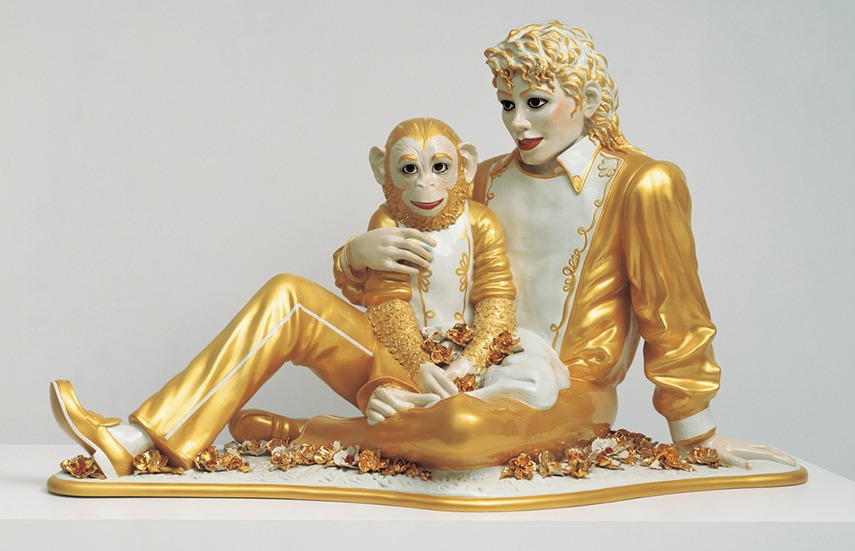
The Most Iconic African-American Effigy aka Michael Jackson
Michael Jackson is such an iconic effigy that even long after his death he'due south still making more than $1 billion in postmortem earnings. Because of his ultimate-star status and his philanthropic legacy which is almost every bit large as his cultural one, information technology's not surprising that and then many contemporary art pieces focus on his work and appearance. 1 of the most famous artworks inspired by Jackson is a precious porcelain sculpture entitled Michael Jackson and Bubbles, fabricated by Jeff Koons. This sculpture was made in 1988 and it belongs to Koons' Banality series. Jeff Koons has stated long ago that his goal is to achieve the widest possible audience, which he surely did past choosing Michael Jackson as a source of inspiration for his art.
Pop Culture Icons
If we have the definition of popular culture every bit a vast range of technologically avant-garde cultural products consumed and used for a variety of purposes by a wide range of audiences, we tin argue that the realm of everyday consciousness becomes i whose significations are indistinguishable from these images, spectacles and letters that circulate through mass media and pop civilisation. In different ways, this cultural capital becomes a central office of the materiality of our world. Whether being celebrities, fictional characters, or objects, popular culture icons accept played a great function in constituting the world around us as cultural signifiers. Every bit defining characteristics of a given social club or era, pop icons turn out to exist intricate, flexible, polysemous and multi referential entities. Part of their mythical quality lies in the fact that they are extensively used in a diverseness of contexts without ending up as worn out and depleted cultural artifacts.
The Celebrity Culture
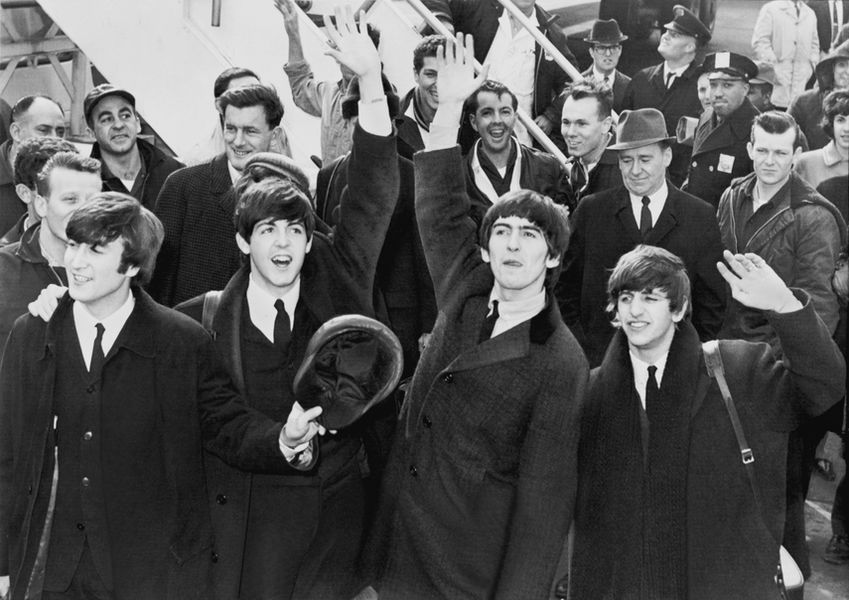
Ever since the early radio personalities gained widespread fame,glory culture has been crystallizing and spreading broadly, becoming socially all-embracing. As a perceptive observer of pop civilization trends, Andy Warhol noted that anyone tin take their "fifteen minutes of fame". He was the first creative person to realize the intrinsic connection betwixt celebrity culture and pop culture. According to Warhol categories, a celebrity is a person, fictional graphic symbol, or commercial production that garners a loftier degree of public and media attention while being on the media phase. Only those celebrities who get extremely popular and symbolic of something become known equally pop icons. The term "icon" represents something easily recognizable, but information technology likewise has a religious sense. As these popular icons are often perceived equally larger than life, this glory-making upshot of pop civilization is actually mythologizing. These mythic personages are created by a media stage simply by existence suspended in a mythic reality of their ain.[xi]
Condign a Pop Icon
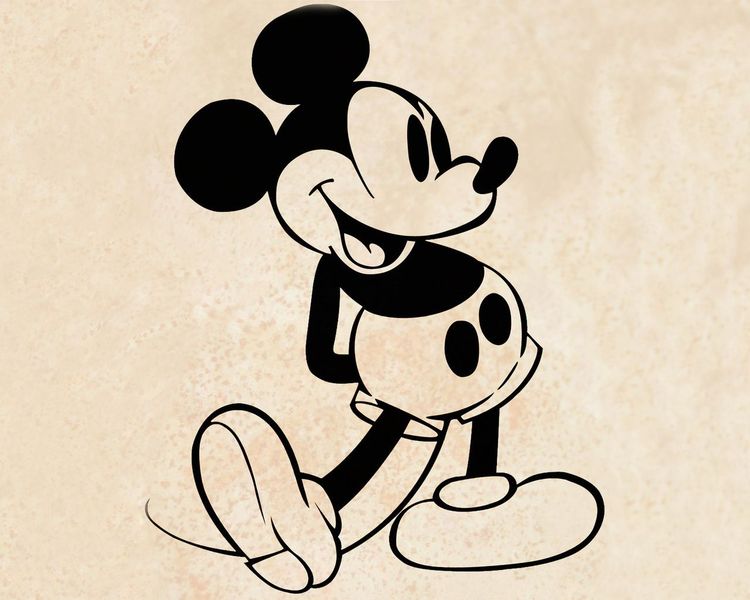
As Byzantine and other Eastern Churches' craftsmen knew, the fabric from which an icon is made requires certain specific qualities. Pop icons are usually associated with elements such every bit longevity, ubiquity and distinction. As some celebrities have left a lasting and indelible mark in their fields and managed to maintain their popularity through generations, they attain a lasting identify of recognition in society at big - condign pop icons. Another mutual chemical element of popular icon status is the ubiquity of imagery and allusions to the iconic figure. These figures are often recognized and celebrated in areas outside their original source of celebrity status. For example, Che Guevara went from being a communist revolutionary to a popular icon whose image has been capitalized, commercialized and exploited in a variety of means in the consumer marketplace. Still, the most powerful force in the preservation and continuity of pop culture and its icons through the ages is definitely nostalgia. It is woven in the fabric of contemporary pop culture...
The Affect of a Pop Icon
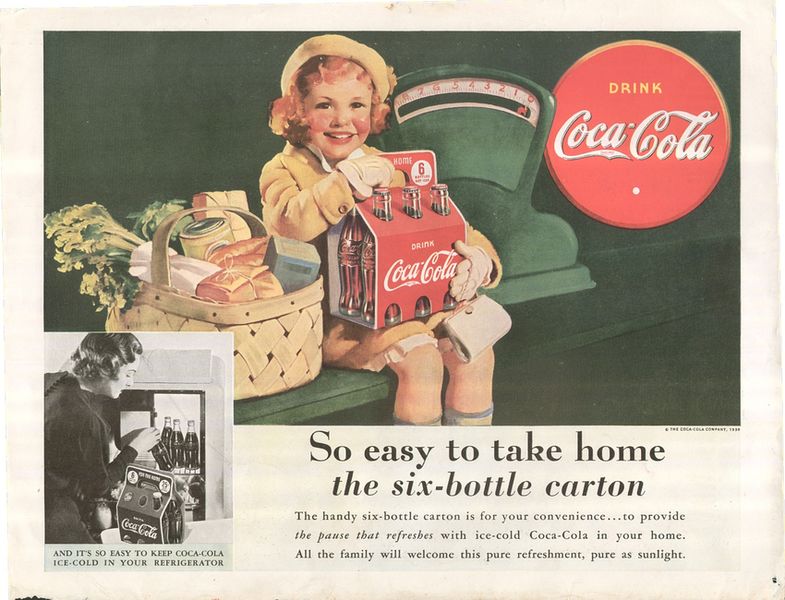
An icon is not a passive symbol, only 1 which in itself is deemed to be a touchstone of transformative power.[12] From their clothing styles to speech mannerisms or behavior, pop icons and celebrities influence society broadly, also as our views. They have a sure mixture of sign systems that nosotros can participate in equally fans. For many people, talking well-nigh pop icons of today can often serve as a fashion to discuss issues such as gender, race, and course in terms that they sympathize. Even though pop icons are artifacts recognized equally ones representing some aspects of cultural identity, the values, norms and ethics they stand for and symbolize can vary greatly amongst people who subscribe to it. Offered meanings of cultural sign systems are not passively digested, but the consumption of pop culture mythology fluctuates in different realities and contexts.
eight Pop Culture Icons and Examples
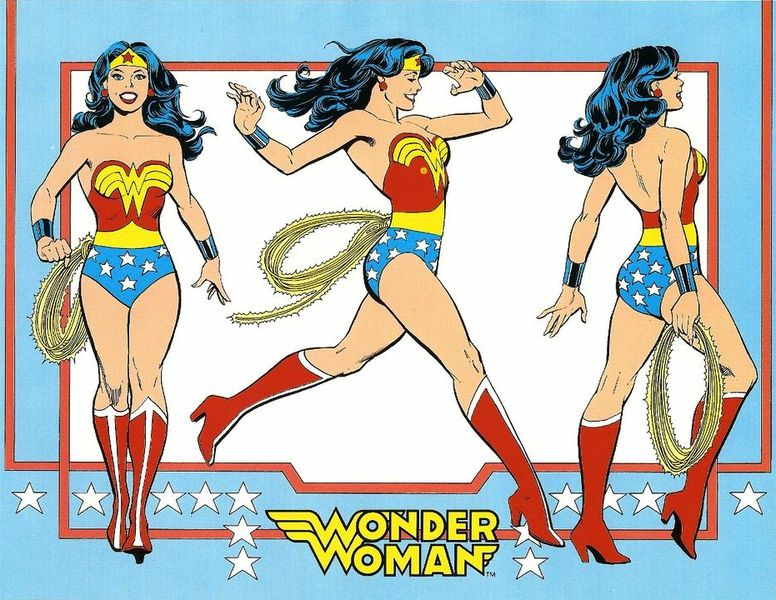
How does one make a selection when faced with a disarray of choices? When it comes to pop culture icons, there are several instances that are decisive. Primarily, information technology is the bear on that a character, persona or object (symbol) achieves. This affect is fueled by significant incorporated in the ability of an icon-in-the-making. Many times, this meaning is not clear to u.s.. An icon can exist in the symbolic realm of media and public life long before nosotros can decipher what had made it extraordinary. Secondly, a popular civilisation icon is "tested" past time or its longevity. In the 21st century, this can be measured differently as temporality has go a relative factor under the influence of such traits as shares, likes, impressions, views, discussions and so on. Thirdly, a pop culture icon continues to be due to its "familiarity" - a trait related to the meaning behind it and its longevity. Today, this tin most notably exist seen in symbology related to nostalgia. Pop civilisation has go an empire of reboots, rehashes, appropriations and copies, only more on this later on. Finally, information technology seems that there is another "level of being" of a pop culture icon. It is the i that comes to being when the symbolic meaning of the icon becomes part of a contemporary artist's practice. It could be argued that this example renders the popular civilization icon a novum. The icon enters the arena of contemporary art and exits with a new layer of meaning bestowed upon it past the analyst of the zeitgeist that is a contemporary artist. Thus, we look at some notable examples spanning across diverse popular civilization industries, including artists that take decided to mold the material already made of stars… You are left to dwell upon what are the new layers of meaning (and, maybe, more importantly, purposes) ascribed to them.
Lady Gaga practicing the Abramovic Method
Renowned Serbian creative person Marina Abramovic is known for her ground-breaking performances also as many collaborations with both fellow visual artists and those coming from different realms of the art globe, such equally the pop musician Lady Gaga. In 2013, the performance artist instructed Lady Gaga in the Abramovic Method, which is a series of physical and mental exercises designed to raise the participant's awareness. In return, Lady Gaga financially supported the Marina Abramovic Institute, which is defended to the presentation and preservation of performance fine art, dance, music, and other forms of art that may develop in the future.

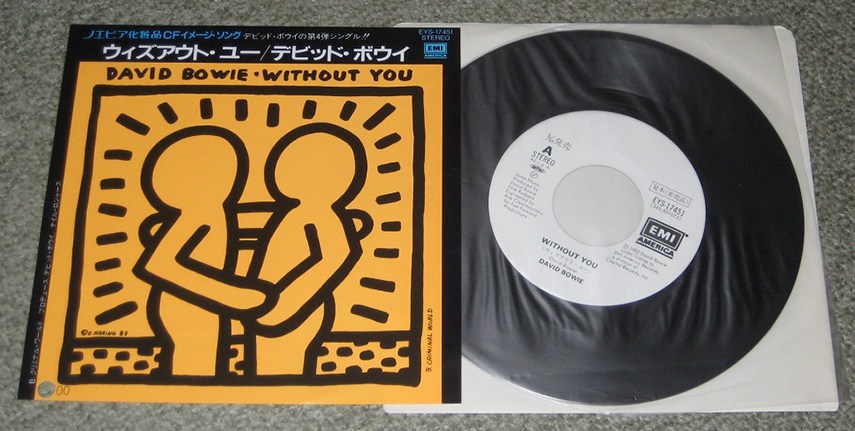
David Bowie's Without Y'all by Keith Haring
In 1983, David Bowie and Keith Haring, legendary American artist and activist collaborated on the artwork for the unmarried entitled Without You. This simple yet powerful slice of fine art appeared on Bowie's album Let'due south Trip the light fantastic, which was released as a single past EMI America in the netherlands, the US, Japan and Kingdom of spain in the fall of 1983. David Bowie was a great fan of the New York Metropolis-based artist and he already had many of Haring's pieces in his private collection. Bowie'due south Let's Dance album had another artwork on the backside, a photograph taken past his long-term collaborator Denis O'Regan.
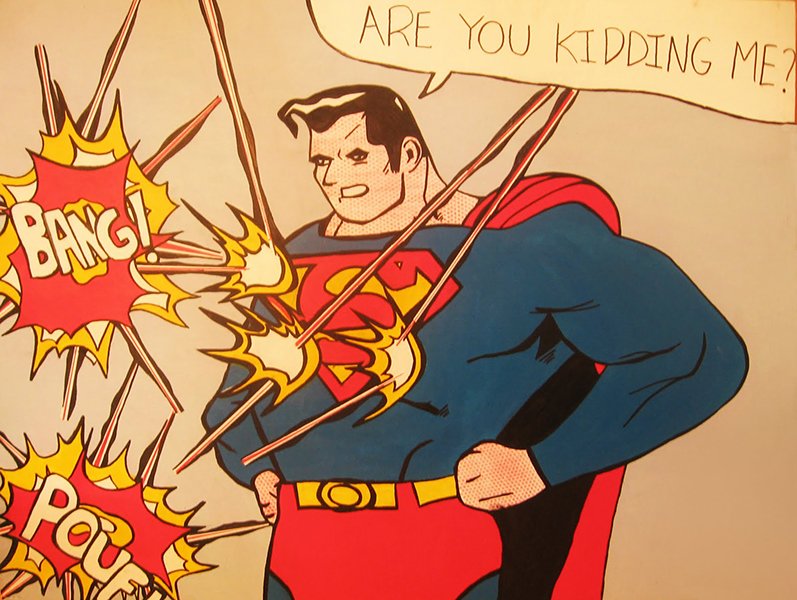
A Truthful Comic Book Gem - Roy Lichtenstein's Superman
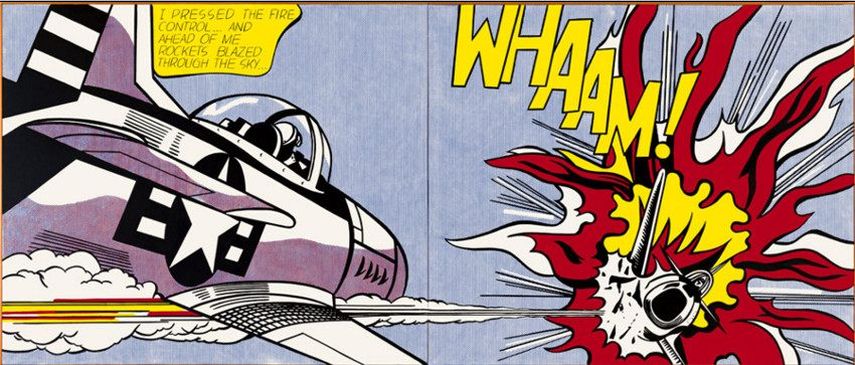
The hugely successful US creative person Roy Lichtenstein is best known for his series of War and Romance paintings, derived from various popular comics. Fifty-fifty though he abased the comic book fine art subject later in his career, he continued to utilise the same drawing style he developed over the years, such as the limited palette and blackness outlines. His depiction of Superman, one of the most famous fictional superheroes appearing in American Detective Comics, likewise relies on this trademark comic-book style. When it comes to Superman, the character was originally created in the early 30s by Jerry Siegel and Joe Shuster, high schoolhouse students from Cleveland, Ohio.
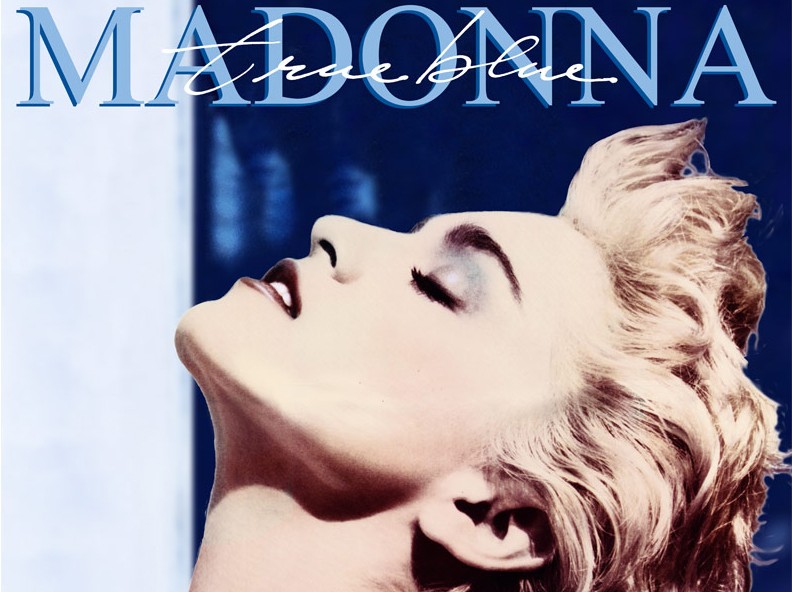
Madonna'due south Elegant True Blue Cover Shot past Herb Ritts
Madonna's iconic True Blueish anthology cover from 1986, shot past fashion photographer Herb Ritts, became one of her most pop pictures. The main colors used in this elegant image are gray, white and shades of blue, which reinforces the album'southward title. Several images from Ritts' photoshoot with Madonna were considered for the album cover, but the final photo was selected by Madonna herself, Heiden and Jeff Ayeroff, who was the creative director of Warner Bros. Even though the original image was in black and white, only similar the residue of Ritts' work, photo editors experimented with diverse colour tones and agreed upon the blue-toned, mitt-painted version of the photograph.
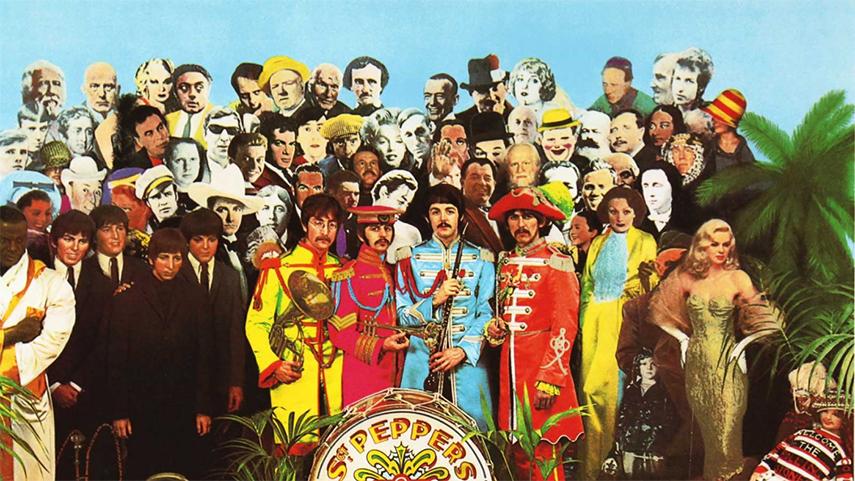
Hippies and Flowers - Peter Blake'south Portrayal of the Beatles
Sgt. Pepper's Lonely Hearts Club Ring is the eighth studio album past the Beatles and it was released in 1967, during the vibrant hippie era. Sgt. Pepper's album cover, humorous, warm and detailed, just like the hippie scene itself, was designed past the iconic pop artist Peter Blake together with Paul McCartney, who did an initial sketch in ink. The colorful collage features the Beatles continuing with a grouping of cardboard cut-outs of famous people, surrounded past flowers. Each of the Beatles wore a heavy mustache, which again reflected the influence of the hippie tendency. For his artwork on Sgt. Pepper, Peter Blake won a prestigious prize - the 1968 Grammy Award for Best Album Cover, Graphic Arts.
The Chupa Chups – Salvador Dali's Logo Design
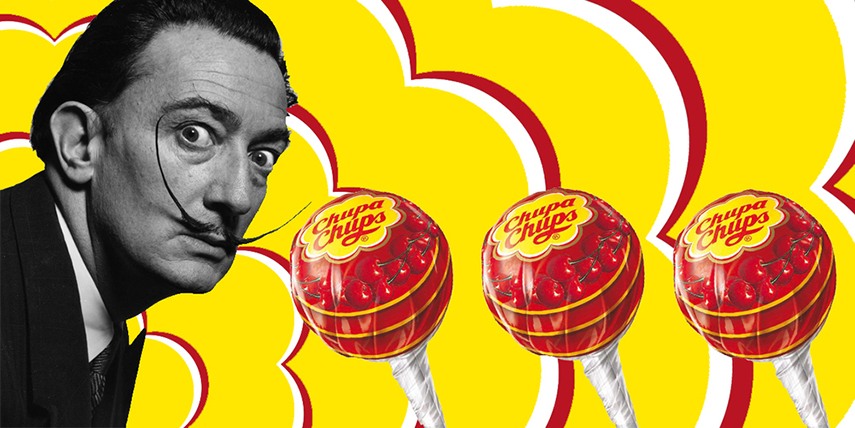
The Chupa Chups packaging is recognizable from miles away - those curly letters on the yellow daisy groundwork are certain to make everybody smile in anticipation of the sweet and fruity flavor. The designer behind this elementary yet sweet and memorable logo is one of the near influential surrealist painters, Salvador Dali. The Chupa Chups was founded in 1958 and in 1969 this number-1 lollipop company from Espana decided they needed a logo redesign. Since then, the logo has gone through a couple of minor adjustments, but it is still one of the all-time known and most loved logos in the candy industry worldwide.
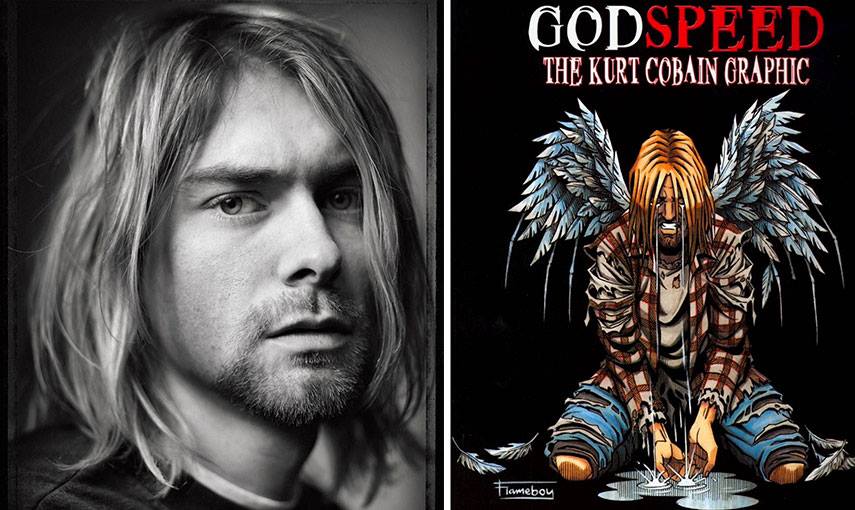
Last True Rock Star – Kurt Cobain Photographed and Illustrated by Mark Seliger and Flameboy
It is often argued that Kurt Cobain was the concluding true rock star. Millions of fans worship Cobain fifty-fifty today, long after he was found dead at the age of 27, and then it's non surprising that his image inspired many different artworks – from photography and fine art to illustrations. Near of the people and non simply difficult-core fans will easily recognize Cobain'due south bare expression, equally the reproductions of the photograph tin be found on many t-shirt designs. This iconic portrait was taken past Mark Seliger, a photographer famous for his celebrity portraiture. Another Cobain-inspired piece is a graphic novel written by James and Jim McCarthy and illustrated past Flameboy.
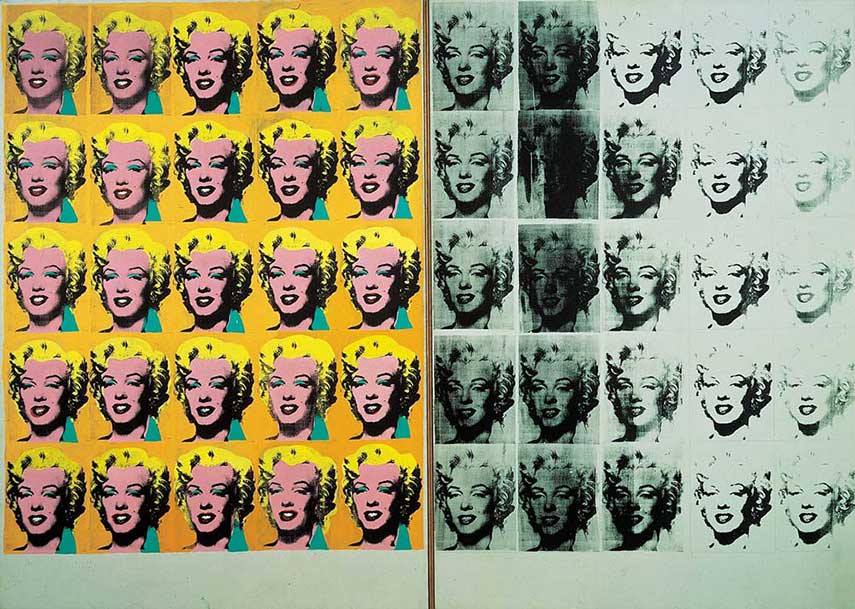
Timeless Diva and Andy Warhol'south Honey Muse – Marilyn Monroe
Besides being one of the first Hollywood divas, Marilyn Monroe was an inspiration for Andy Warhol'due south most pop piece, Marilyn Diptych. Warhol made this artwork a couple of weeks afterward Monroe's death in August 1962. The photograph which Warhol duplicated fifty times is a publicity photograph from Niagara, the film which was ane of the main milestones in Marilyn Monroe's brusk but brilliant career. The piece is currently owned past Tate and it is considered the third near influential piece of modernistic fine art co-ordinate to The Guardian, right later on Marcel Duchamp's controversial Fountain and Picasso'due south Les Demoiselles d'Avignon.
A Never Ending Story. Literally.
The nature of interpreting popular culture is a never-ending do in itself. At that place is a myriad of processes incorporated in the act of deciphering and understanding numerous instances that constitute popular culture. Ever since the offset popular radio evidence or a slice of pop literature, pop civilisation texts take started growing into narratives that have gone across their initial purpose and significant. They take go platforms for discussions on non only important topics but fifty-fifty profound ideas and concepts. When nosotros look at textual assay as a course of trying to discover what lies beyond the symbolic universe of our "cultured" reality, nosotros find ourselves "in possession" of a powerful tool that takes into account the object of our attending, as well as its context, possible purpose, its political and ideological nature, etc. It seems that the present twenty-four hours has fabricated adept textual analysts out of all of us. Every "text" or "cultural artifact" residing within the realm of popular culture (pieces of fine art included) cannot be just seen, it is realized in a sure context, "polluted" with additional layers of significant. But, is that bad?
For, it is that interaction that the public has with a certain popular civilisation "object" (be information technology a celebrity, pop icon, meme, artwork or something else) that has created a different kind of universal context where we commutation ideas, fight for a voice and make up one's mind the existence of meaning. This kind of a situation has led theoreticians (and that might be all of us) to the realization that soapbox does not merely explicate that which is perceived merely creates information technology. In an era when popular civilization hadn't encompassed all of our reality (as the digital space does today), information technology was a specific "duty" or, better notwithstanding, a calling of an artist to create visual and other cultural symbols in order to construct meaning (various discourses) about ideas and issues. But like surrealist artists, under the burden of having i single reality to dwell upon, turned to the otherworldly imagery coming from deepest corners of their minds, or how performance artists challenged the norms of established societal systems, so do the artists of today - they interpret the reality constructing information technology anew. And this reality establishes itself equally pop culture. One major deviation to the times one century ago, contemporary artists have all of u.s., the public, the active public, following each pace of the manner. Today, artists are political activists, conveyors of ideologies, or, if you volition, par excellence discourse mongers. Only if we expect at the field of Street Fine art, we can observe examples of the mentioned roles. More than than thirty years ago, New York graffiti artists have been creating and spreading an thought of their community's identities through such an innovative and convincing way. Those stories and narratives now resonate in the realm of popular culture, fix to transmit narratives explaining issues such equally race, the economic construction of societies and and so on. Coming to a more recent example, when we look at the practice of Ai Weiwei, an artist coming from a different cultural context than that he is fighting to interpret, nosotros see an private, joined with the public, on a quest to interact with a crucial political issue of the Western world, i.e. the migrant crisis. He constructs the narrative with his creative expression, he addresses information technology within real-earth cultural space, still his message strongly lives on Instagram, open to interpretation and deliberation.
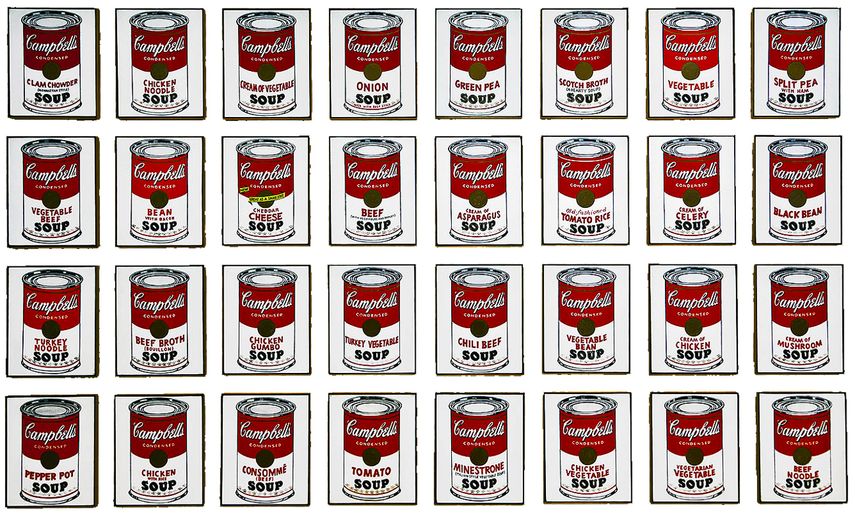
But, we accept long lingered on the processes of our topic, the fluctuations within popular culture. What of the concepts, what of the "texts" or "artifacts" themselves? In the eclectic assemblage of popular culture icon examples, we have tried to point out how an artistic vision of a sure symbolic manifestation becomes something more than. It becomes a vessel of sorts, reimagined only to exist ready free back in its natural habitat, shedding lite on such, still very much today, relevant concepts: race, gender, identity, body, integrity, socio-political rights… This is where the importance of the active audience, agile estimation comes into play. A tin of Campbell Soup is not but a tin can of food; Lichtenstein's interpretation of the nigh iconic pop culture artifact isn't only a representation of a superhero; the moment Alberto Cobra captures history isn't merely a face of a man; or even the seemingly kitschy form of Koons' portrayal of Michael Jackson - all of these artifacts are in constant motion powered by the action of the public, which in the post-Google era exist fueled with the highest of potential. It'southward all in that location - in the pantheon of the gimmicky society nosotros have come up to identify as popular civilization.
And then, why is this important? "Word is God." The power of a symbol can mystify and demystify that which matters: a suffering individual or community, a foreshadowing of a society-challenging upshot or a globally recognized upshot. Or, even if nosotros should talk of "smaller-calibration" - a coming-of-age or possibly an important life-altering story tin can residual inside a atypical symbol but exercise to the fact it is layered with meaning. One volition see a simple photograph of a immature person and another all the meaning behind the images and words such equally "Che" or "Kurt Cobain" or "Wonder Woman". These can be simultaneously understood every bit symbols of seeming abyss of nothingness and stories of revelation, inspiration and inventiveness, specific power, and so on… Perchance, artists represent figures that can tap into the discursive potential exploding from numerous objects residing in the realm of popular culture? Be that as it may, should all of us have this potential, why not employ it?
Finally, in that location has been the talk of possibility and not so much on control backed with power. The market, influential subjects and certain groups control and manipulate the symbolical world of popular culture. This is present today, it would seem, more than than ever. The shallow exploitation of nostalgic aspects of imagery and linguistic communication already embedded in our minds has spawn mass production of rehashed, rebooted (re)appropriated, reacted and reproduced symbols in social club to invite the public to become active not only equally an interpreter just every bit a consumer. In this field, the dichotomy command-resistance shines equally a beacon of possibility. There will always be forces that will try to manipulate public stance and steer their actions. On the other hand, in that location will ever exist individuals who tin recognize and use the vastness of popular civilization in order to find and hash out that which is important. What is more than, art will never escape the pop culture and the market place and - if I can humbly contribute - nor information technology should. The agile perceiver (the public) is a consumer, merely besides a critic, a judge and, most importantly, a creator. He or she connects with others through concepts in gild to decide what will live on and (perhaps too optimistically) pave the route for a new Haring, Bowie, Lichtenstein, Banksy… Popular culture is, after all, more than than a network of meaning, symbols, voices and endless copies; it is the neverending story of our existence; information technology is our mythos. Or, at to the lowest degree, it should exist…
Special thanks to my love colleagues Elena Martinique, Jacqueline Clyde and Frederic Godward for their indispensable enquiry and contribution.
References:
- Barker, C, Making sense of Cultural Studies, Sage Publications, London, 2002
- Morley, D, Audience Research, Museum Tv [September 29, 2016]
- Kovala, U. (2002) Cultural Studies and Cultural Textual Analysis, Comparative Literature and Civilization four.4 [September 29, 2016]
- Barker, C. Galasinski, D. Cultural Studies and Soapbox Analysis, Sage Publications, London, 2001.
- Milestone, K. - Gender and Popular Civilisation, Polity, 2012.
- Zeisler, A. - Feminism and Pop Civilization,Seal Studies, 2008.
- Reed, C. - Fine art and Homosexuality: A History of Ideas, OUP USA, 2011.
- Ashton, J. - AIDS in New York: The Offset Five Years, Scala Arts & Heritage Publishers Ltd, 2015.
- Sowell, T. Race and Civilisation: A World View, Basic Books, 1995.
- Dines, Thou. Gender, Race and Class in Media: A Disquisitional Reader, Sage Publications, 2014.
- Danesi, M. Popular Culture: Introductory Perspectives, Rowman & Littlefield Publishers, 2015
- Delanoy, W. Helbig, J. James, A. Towards a Dialogic Anglistics, Lit Verlag, 2007
Featured epitome: Woodstock, Photo courtesy of Creative Commons.
Source: https://www.widewalls.ch/magazine/blurred-lines-of-popular-culture
0 Response to "Famous Artworks That Bring Raceethnicity and Cultural Identity in Art"
ارسال یک نظر